Metal hardware is what keeps every structure together. However, despite this, it’s also one of the first components to fail when exposed to the wrong conditions, causing corrosion.
Many homeowners are often surprised when they see rusted bolts, screws, or connectors in seemingly “dry” places. Though dry, stress corrosion can slowly damage the hardware through tension, humidity, and chemical exposure.
Because of this, it’s important to use the right hardware in the right location. That’s why we’re going to compare the main hardware materials on their stress corrosion resistance below.
What is Stress Corrosion
Stress corrosion is a form of metal deterioration that happens when metal under tensile stress is exposed to a corrosive environment, like moisture or chemicals. Over time, the combination of stress and a corrosive environment can cause microscopic cracks and corrosion that wouldn’t occur with stress or moisture alone.
The Problem with Standard Hardware
Homeowners are often surprised when they find rusty screws, bolts, or plates in areas that seem dry. For example, crawl spaces may not show visible water, yet wood near the ground often holds enough moisture to corrode standard hardware over time.
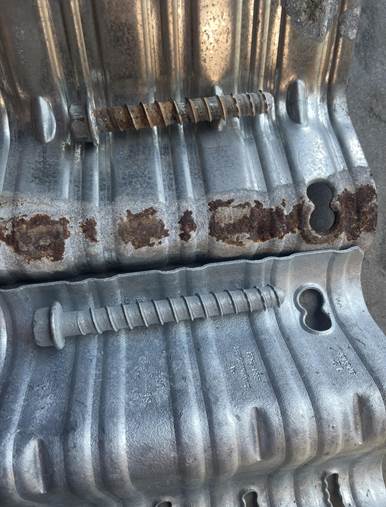
Accordingly, we’ve seen zinc-coated hardware rust in just two years in a “dry” crawl space. Zinc, however, is the industry-standard. In the image below:
Zinc Fastener Above After Two Years of Usage in Dry Crawl Space (contact with redwood mudsill and concrete foundation, no contact with pressure treated lumber), and HDG URFP Hardware Below
Hardware Material Comparison for Stress Corrosion
Not all metal hardware is created equal. Different materials and coatings offer varying levels of protection and performance.
Regular Steel
- Corrosion Resistance: Low
- Durability: Low
- Cost: Low
- Code Acceptance: Low
- Environmental Suitability: Dry interior only; not for crawl spaces, exterior, concrete contact, or pressure-treated wood.
Regular steel, often called bright steel, is strong but completely unprotected against corrosion. Without any coating or galvanization, it quickly rusts when exposed to air, moisture, or contact with wood or concrete. Under stress, corrosion speeds up.
Therefore, this material is only recommended for completely dry indoor environments. Think of interior framing or furniture assembly. It shouldn’t be used for anything structural or anywhere that has humidity.
Zinc
- Corrosion Resistance: Low to Medium
- Durability: Low to Medium
- Cost: Low
- Code Acceptance: Low (generally interior, non-treated applications only)
- Environmental Suitability: Dry indoor areas or very mild conditions; must avoid exterior exposure and treated lumber; although allowed, it is recommended to avoid crawl spaces and contact with interior concrete due to possible corrosion.
Zinc-coated steel, also known as electroplated galvanized, offers a thin protective layer that delays rust. However, it doesn’t prevent it long-term. Once the layer wears off or if a crack appears, corrosion can speed up rapidly.
Generally, zinc fasteners are okay for dry interior applications, like framing or furniture. For outdoor projects or treated lumber, they must not be used. For crawl spaces or contact with interior concrete, they shouldn’t be used as the coating may begin to rust.
Mechanically Galvanized
- Corrosion Resistance: Medium
- Durability: Medium
- Cost: Low to Medium
- Code Acceptance: Medium when coating meets ASTM/ESR (e.g., Class 55/65)
- Environmental Suitability: Interior or light exterior; acceptable for some retrofit/concrete anchors; avoid coastal or continuously wet locations.
Mechanically galvanized hardware has a much thicker zinc layer than electroplated steel. Therefore, corrosion resistance is improved. The coating, though, is only mechanically bonded and can chip or flake under load, exposing the steel underneath.
For performance, it’s okay. It is the next step up from zinc for many hardware applications. Typically, it’s used for light exterior work or semi-protected environments. It can even be used as an upgrade to zinc for concrete anchors or retrofit work, depending on the environment.
Hot-Dipped Galvanized
- Corrosion Resistance: High
- Durability: High
- Cost: Medium
- Code Acceptance: High (commonly required for treated wood/exterior)
- Environmental Suitability: Exterior and damp areas, crawl spaces, treated lumber, and concrete interfaces; not ideal for severe marine spray zones.
Hot-dipped galvanized (HDG) hardware offers one of the most corrosion-resistant coatings available. The steel is deep in molten zinc, creating a thick, bonded layer that protects against moisture and stress corrosion.
Generally, it’s the industry-standard for decks, anything exterior, and treated-wood applications. In some cases it is required, but at least always recommended for all crawl space work and foundation retrofits. Due to how the coating is applied, it offers long-term performance even in humid or damp environments. Please note, not all hardware is available in this option.
Simpson Strong Tie’s ZMAX
- Corrosion Resistance: Medium-High
- Durability: Medium-High
- Cost: Medium
- Code Acceptance: High (G185-level heavy galvanization)
- Environmental Suitability: Exterior and treated-wood connections (decks, crawl spaces, seismic retrofits); good general choice short of harsh marine exposure.
Simpson Strong-Tie’s ZMAX uses heavy galvanization, around double that of zinc. This ensures that it resists corrosion from moisture and pressure-treated wood.
Mainly, this is used for exterior and high-humidity applications, like decks, crawl spaces, and seismic trusses.
GRK’s Climatek
- Corrosion Resistance: High
- Durability: High
- Cost: Medium
- Code Acceptance: High (AC257/ICC-ES approved as HDG alternative)
- Environmental Suitability: Exterior structural and treated-wood uses, including crawl spaces and most coastal neighborhoods; avoid direct marine immersion/submersion.
GRK’s Climatek coating is a multi-layer finish that combines zinc and polymer protection. Tested under AC257 and ICC-ES standards, it meets and exceeds the corrosion resistance of hot-dipped galvanized hardware.
Due to their high resistance levels to stress corrosion, they are ideal for exterior structural work, crawl spaces, and treated-wood applications. The only real limit is direct marine or underwater environments.
Stainless Steel
- Corrosion Resistance: High
- Durability: High
- Cost: High
- Code Acceptance: High
- Environmental Suitability: Best for coastal/foggy or continuously damp areas; ideal for treated wood, concrete interfaces, and long-life exterior work.
Stainless steel fasteners are an excellent option for corrosion resistance and longevity. Containing chromium and often molybdenum, they naturally resist rust and stress corrosion without needing any additional coating.
You get two main types of stainless: A2 and A4. A2 is resistant to all non-salty water, and A4 is for saltwater protection. Therefore, A2 is used for most damp locations and A4, more coastal environments.
Comparing Hardware Materials for Corrosion Side-by-Side
| Material | Corrosion Resistance | Durability | Cost | Code Acceptance | Environmental Suitability |
| Regular Steel | Low | Low | Low | Low | Dry interior only |
| Zinc-Coated Steel | Low-Medium | Low-Medium | Low | Low | Dry indoor or mild conditions |
| Mechanically Galvanized | Medium | Medium | Low-Med | Medium | Interior or light exterior |
| Hot-Dipped Galvanized (HDG) | High | High | Medium | High | Exterior, damp, and crawl spaces |
| Simpson Strong-Tie ZMAX® | Medium-High | Medium-High | Medium | High | Exterior and treated-wood use |
GRK’s Climatek | High | High | Medium | High | Exterior, treated wood, coastal |
| Stainless Steel (A2/A4) | High | High | High | High | Coastal, foggy, or damp areas |
What Hardware Material Should You Use?
The right hardware material depends on where and how it’s used. For dry indoor areas, zinc-coated fasteners can be used. However, in crawl spaces, basements, and outdoor projects, upgrading to at least hot-dipped galvanized or Simpson Strong-Tie’s ZMAX hardware is recommended.
For homes that are near the coast or exposed to high humidity, stainless steel hardware and fasteners are the best options. These can resist stress corrosion and even damp or salty air (A4 stainless steel only)
Why Should You “Upgrade” Your Hardware Material
When compared to regular steel, the costs of other fasteners with better stress corrosion resistance levels are higher. Therefore, why should you consider the upgrade?
Prevent Costly Repairs
The main reason is that corroded fasteners and connectors can lead to serious structural damage over time. Replacing rusted hardware often means taking apart prior work, which can be labor-consuming and expensive.
Invest in better hardware now, prevent replacement in the future.
Invest in Durability
Upgraded materials like HDG, ZMAX, and stainless steel are built to last. They maintain their strength under tension, resist environmental wear, and prevent premature hardware failure, making them much more durable.
Protect Against Hidden Moisture
Even “Dry” areas like crawl spaces or basements often hold enough humidity to trigger corrosion. Upgraded hardware provides a safety margin against these threats, ensuring that your connections remain structurally sound for years to come.
Conclusion
Choosing proper hardware isn’t just about meeting the standard code. It’s about protecting your home’s structure for the long term.
Stress corrosion is a serious problem. Quietly, it can weaken connections in areas that may appear dry. Therefore, it’s highly important that you choose quality hardware materials from the get-go.
For most Bay Area homeowners, hot-dipped galvanized (HDG) and Simpson Strong-Tie’s ZMAX hardware is a good option. This balances cost and corrosion resistance perfectly. For more coastal areas, stainless steel (A4) hardware and fasteners are recommended. Upgrading your hardware today means avoiding costly repairs tomorrow.
For guidance with comparing hardware materials for corrosion or installation, feel free to contact our professionals at Avant-Garde
In earthquake-prone regions, building owners and developers need to weigh up their design approach carefully.
Typically, there are two paths: meeting code-based standards or pursuing a custom, performance-based seismic design.
The best option? Well, that depends on your goals and needs. That’s why we’ll compare both options side by side below.
What is Code-Based Seismic Design
A code-based seismic design refers to designing a building or retrofit in strict accordance with the local, regional, and national building codes.
The goal of such a design is to protect life. It’s been developed by the International Building Code (IBC) to ensure the structure won’t collapse and occupants can safely evacuate during a code-defined earthquake event.
This approach provides clear, prescriptive standards that professionals can follow, and if these standards are met, the building will be compliant with legal safety mandates.
A big problem is; however, that many times these standards are not even being met due to poor implementation and lack of proper inspections.
What is Performance-Based Seismic Design
A performance-based seismic design is a tailored, goal-oriented approach to earthquake design. It goes beyond the one-size-fits-all code approach and offers a bespoke option set to meet specific seismic performance objectives.
Following this approach doesn’t only focus on life safety. It also helps control damage and functional recovery after seismic activity. For example, the expected damage, repair costs, and downtime under certain strengths of seismic events.
Rather than following the generic code formula, professionals can use advanced analysis techniques to predict the building’s response to various earthquake scenarios, designing the structure to meet performance targets.
Pros and Cons of Code-Based Seismic Design
Code-based seismic design is the default for most projects, especially those that are budget-friendly or don’t need to meet special performance requirements.
Pros
Lower Initial Cost
For most projects, designing for code is the most affordable option upfront. You are only meeting the minimum required strength and detailing requirements, meaning less reinforcement, fewer specialized materials, and simpler retrofit or construction.
Clear Standards
Another benefit of code-based seismic design is that it’s backed by clear, standardized criteria. Simply, they provide a universally applied set of rules and calculations that engineers, contractors, and building officials all understand.
Due to this, it means the design and construction process is relatively straightforward. Normal processes and materials are used, so there’s a reduced need for specialized expertise, equipment, or goods.
Meets Legal Compliance
Designing a building to code is the law. By using a code-based design, you guarantee that your building meets all the legal compliance requirements.
By following the code, owners can be confident that they are meeting the required legal obligation for earthquake safety.
Cons
False Sense of Security
Many homeowners go this route; however, other contractors typically overlook critical requirements— leaving you with a seismic retrofit that will not perform as expected.
Uncertain Post-Earthquake Usability
The biggest drawback of code-based design is what happens after the earthquake.
While a code-designed building is unlikely to collapse, there’s no guarantee that it will be usable or safe to reoccupy in the aftermath. In fact, the code allows the building to sustain significant damage as long as lives are protected.
Therefore, even when a building meets code, it can be unusable for months or even condemned, resulting in loss of housing, revenue, etc.
Hidden Financial Risks
A code-based design is a cheaper alternative upfront. However, it doesn’t account for the aftermath damage for things such as downtime or loss of residence.
If a code-compliant building is badly damaged by an earthquake (a very real possibility), the owner may encounter massive repair bills, business interruption costs, and more.
One-Size-Fits-All Approach
Regardless of the building’s specific use or the owner’s priorities, a code-based seismic plan is almost the same for all buildings.
The major issue with this is that not all buildings and building owners have the same requirements. A building, for instance, like a museum with priceless artifacts, needs a very different seismic design plan from a residential house.
Pros and Cons of Performance-Based Seismic Design
Despite being more expensive to develop, a performance-based design offers protection based on the owner’s goals. This level of design allows you to construct a building with aftermath priorities aligned.
Pros
Tailored Protection to Goals
With a performance-based design, you tailor your seismic protection to the owner’s specific goals. Therefore, you’re not limited to the code’s single performance level.
Instead, the owner defines what “success” looks like for a building after an earthquake. For example, whether the building is fully operational immediately after a major quake or if it can take a few weeks to repair.
That’s just one instance as well, it could be how much repairs cost, where the building can and cannot collapse to protect certain goods, and so forth.
Essentially, using a performance-based seismic design allows owners to align the design with their business or operational needs.
Reduced Downtime and Quicker Recovery
Alongside the above, you can reduce the downtime a property encounters. This can be done through the design stages.
Simply, the owner chooses an appropriate downtime for the building, and the engineers design it in a way that the building meets those requirements after a quake.
For example, a hospital needs to be instantly available after an earthquake. In this case, it’ll need to be designed using a performance-based seismic plan that allows for such protection.
Better Risk Transparency
Naturally, with a performance-based seismic design, you get more information and insights into your building and its earthquake protection.
This allows building owners to get a clearer picture of the expected earthquake performance under multiple quake strengths.
It’s possible to then use this information to plan for such events. For example, a building can be designed to suffer $500k in damage after a 7.0 earthquake. By knowing this, the owner, business, etc., can then ensure they have these funds on standby in case it happens.
Long-Term Value and Resilience
Alongside the above, investing in performance-based seismic design can provide long-term value for property owners and communities.
While it may cost more upfront, the payoff is a building that is far less likely to encounter catastrophic damage or require lengthy closure after a quake.
Cons
Higher Upfront Cost
Due to the research required, specialized expertise, etc., the cost of a performance-based seismic design has much higher upfront costs.
There’s no way around it. Aiming for better seismic performance will require a bigger investment during design and construction.
Greater Complexity
By nature, a performance-based seismic design is more complex and involved than a code-based design. The planning, skills required, and the materials used are different and often require specialized expertise.
For example, when it comes to designing the building’s structure, complicated analysis techniques are used. The time will simulate dozens of earthquake scenarios and tweak the design to fix weak points to ensure multiple performance metrics are met.
Performance-Based vs. Code-Based Comparison
| Factor | Code-Based Design | Performance-Based Design |
| Goal | Life safety, collapse prevention, meets legal standards. | Protects lives and functionality with owner-defined performance goals. |
| Post-Earthquake Usability | Uncertain – building may be heavily damaged and unusable. | High – can be designed for quick reoccupancy or continuous operation. |
| Upfront Cost | Lower initial cost; most economical. | Higher upfront cost due to added analysis and strengthening. |
| Flexibility | Prescriptive, one-size-fits-all. | Flexible, tailored to building use and owner priorities. |
| Risk Transparency | Limited insight into damage/downtime. | Detailed predictions of repair costs, downtime, and risks. |
| Best For | Budget-sensitive, lower-priority buildings. | Critical, high-value, or long-term facilities needing resilience. |
Which Approach is Best for You?
Deciding between code-based and performance-based seismic design depends on three key factors:
- Building Type: Buildings such as hospitals, data centers, or emergency hubs will usually need a performance-based design to stay functional. Lower-priority structures, such as warehouses, may be fine with code-based compliance.
- Owner Priorities: If minimizing upfront costs and meeting legal requirements is your goal, a code-based design is enough. If you want to protect long-term investment, rental income, etc., performance-based seismic design is the safer choice.
- Budget: Performance-based seismic design will cost more upfront, but can save you on downtime and building damage after a quake. A code-based design, though, will be cheaper initially but may expose you to financial exposure.
At the end of the day, the best options depend on your requirements. Sometimes a standard code design is suitable, while other times, a performance-based seismic design.
Conclusion
When it comes to performance-based vs code-based seismic design, the difference comes down to personal goals.
While a performance-based seismic design can be costly, it can offer more protection. On the other hand, while a code-based seismic design is more affordable, it can cost more in the aftermath.
The best option? It depends on your goals and building. To see which is best for your specific situation, feel free to contact our professionals at Avant-Garde.
]]>We all know that building codes are designed for the safety of lives. That’s obvious. However, they are not specially designed to protect your property, investment, and finances.
That’s why building codes aren’t enough. There are limitations, and these limitations could cause huge personal issues.
What Do Building Codes Actually Guarantee?
Building codes in earthquake-prone regions (like California’s IBC/CRC seismic provisions) guarantee life safety. They are carefully designed so a building intended to such code is unlikely to collapse in a design-level earthquake.
The Limitations of Building Codes in Seismic Zones
While building codes are great for general building, in Seismic Zones, they’re unpredictable. Therefore, a code-based approach has several limitations.
Risk of Collapse Still Exists
All in all, building codes don’t eliminate the risk of collapse. Really, they only reduce it to a level that regulators (those who create the codes) deem as an “acceptable” level.
The code’s overall philosophy is to make a collapse unlikely. However, unlikely is not impossible. Therefore, even if you build a house to seismic code, it may still collapse.
For example, a modern, code-compliant building may have a low probability of collapsing during a “maximum considered earthquake”. But what if the earthquake is more severe than what the code anticipated? Well, failure can occur.
Without question, it’s very sobering when you realise that “code-compliant” doesn’t mean “zero chance of collapse”.
No Protection for Financial Loss or Downtime
A huge surprise to property owners is that, even if your property is code compliant, it can still collapse, causing financial loss or downtime.
What the law cares about the most is that people survive. It doesn’t really care about whether the building is usable or cheap to fix after seismic activity.
As a result, for non-structural features, like cladding, drywall, ceilings, mechanical/electrical systems, plumbing, etc., they have minimal to no code requirements to keep them protected.
For example, after the 1994 Northridge earthquake, many commercial buildings structurally survived. They were, however, shut down and unable to be used due to internal damage, such as in their fire sprinkler systems.
Alongside this, building code doesn’t account for loss of income or relocation costs if your building is unusable. If your home, apartment, or business has to close for a year for repair, that’s not a code violation; it’s an expected outcome under the “life-safety” objective.
Codes Don’t Prepare for Worst-Case Earthquakes
Building codes use probabilistic criteria. Therefore, they prepare us for strong earthquakes but not the absolute worst-case scenario.
Generally, structures are designed for a certain level of ground shaking. This is often measured using past data, but larger-than-ever earthquakes are possible.
Older Buildings Are Often Exempt from Code Updates
Sometimes, older buildings are grandfathered under the codes that were in effect when they were built. As a result, they don’t get updated with “new codes”.
This is only in some areas, though. The Greater San Francisco Bay Area and the Greater Los Angeles Area for example, push homeowners to retrofit their older homes through an incentive program.
Still, this is only an incentive program. Though it can reduce the costs of seismic retrofitting for older homes, it isn’t mandatory.
Example of Building Codes Not Being “Enough”
Time after time, real earthquakes have exposed the issues between code-compliant properties and actual outcomes.
Some of the most popular examples include:
Northridge Earthquake (1994, M6.7)
At the time, California’s seismic building codes were the most advanced in the world. However, in 1994 in Northridge, CA, an earthquake exposed weaknesses in the code.
One of the key issues was non-structural and infrastructure failures. While most modern buildings didn’t collapse (which was to code), the economic losses were estimated to be around $20 to $40 billion.
For example, many hospitals in the region were built to code. However, they still had to shut down because of many broken utilities and sprinkler flooding.
Loma Prieta Earthquake (1989, M6.9)
Bay Area seismic building codes also failed back in 1989 in Loma Prieta. The main issue here was with pre-code buildings, which are mostly buildings built in the 1930s.
Instead of retrofitting them to modern compliance codes (in those times), they were grandfathered to their almost codeless design. As you can imagine, the magnitude 6.9 quake hit this region during these times, and most of these buildings collapsed.
South Napa Earthquake (2014, M6.0)
The South Napa earthquake in 2014 was looked at as a success. A lot of the modern buildings (Napa has mostly buildings built post-2000) survived.
Despite the lack of collapses, however, there was a ton of non-structural damage. There were still ceilings that fell, sprinkler pipes that burst, and more.
In fact, there was only one fatality in South Napa during this quake. This fatality was caused by non-structural damage.
What is the Solution to Building Codes for Seismic Activity?
As you have seen, relying on building codes leave us with potential collapse risk, crippling non-structural damage, and several other vulnerabilities. Because of this, we need to go beyond the code for true earthquake resilience.
Luckily, we can do this by embracing a performance-based approach to seismic design and retrofit. This Performance-Based Design (PBD) focuses on real-world performance outcomes instead of following a “generic” recipe.
With such a design model, which follows FEMA’s P-58 methodology, you define what you want your building to achieve in an earthquake. This allows you to go beyond the “code” requirements and to actual performance-based designs.
How Performance-Based Design (PBD) Can Help
Focuses on Real-World Outcomes
Unlike predictive codes, PBD looks into how a building will perform during and after an earthquake.
Therefore, instead of a one-size-fits-all type of methodology, engineers use simulations, nonlinear analyses, and historical data to predict damage to both structural and non-structural elements.
By doing such a thing, a PBD lets you set realistic performance objectives. For example, ensuring a hospital can reopen within 24 hours or a warehouse within a week, etc.
Alongside this, you can set clear performance goals with a PBD. This allows you to protect what matters most to help minimize potential repair costs.
Quantifies Downtime and Financial Risk
Another huge advantage of PBD is the ability to estimate how much damage and downtime a building may experience in a real earthquake.
Simply, traditional building codes can’t answer such questions. For example, “How long will this structure be unusable?” or “What will it cost to repair?”, etc. A PDB, however, can set probabilistic projections for repair time, cost, and so forth.
This, as you can imagine, allows you to design more strategically. Even a slight change in design could save millions in repair costs or missed revenue.
Enables Smarter, Site-Specific Design
Depending on where your building is located, codes can give broad assumptions across entire regions. These, however, aren’t specific enough.
A PBD, on the other hand, factors in everything. This includes soil conditions, fault proximity, tsunami risks, and various other unique variables specific to your building and location.
Such an approach allows you to make smarter choices when it comes to design, factoring in all environmental, structural, and seismic factors.
Building Code Vs Performance-Based Design
| Feature | Building Code (Prescriptive) | Performance-Based Design (PBD) |
| Primary Goal | Life safety (prevent collapse in major earthquakes) | Life safety plus reduced damage, downtime, and loss |
| Design Approach | Follows predefined rules and minimum standards | Tailored to meet specific performance goals |
| Damage Expectations | Accepts significant damage as long as collapse is avoided | Seeks to minimize both structural and non-structural damage |
| Post-Earthquake Usability | May be unusable for weeks or months | Can be designed for immediate or rapid reoccupancy |
| Risk of Downtime & Repair Cost | Not addressed | Estimated and designed to reduce |
| Non-Structural Components Considered | Limited or optional | Fully included in performance evaluation |
| Customizability | One-size-fits-all based on generic site conditions | Customized for building type, location, and owner priorities |
| Applies to | New construction (mostly) | New and existing buildings; ideal for retrofits |
| Financial Protection | Offers no insight into financial loss | Quantifies potential losses and enables mitigation planning |
Contact Us Today
Understanding the gaps in building code is just the first step. The second step is contacting a seismic retrofit professional, like us, Avant-Garde, to develop a performance-based retrofit plan.
Therefore, contact us today and ensure that your property is above code for unexpected situations. Let us give you peace of mind knowing your building is truly prepared regardless of the severity of the earthquake.
Living in the San Francisco Bay Area offers residents scenic views, a thriving economy, and a vibrant culture. However, it also comes with significant seismic risks, due to proximity to active faults such as the San Andreas and Hayward faults. Ensuring your home is prepared for a potential earthquake is critical, and a seismic retrofit is one of the most effective ways to enhance your property’s safety and resilience.
A professional home seismic retrofit involves reinforcing the structure of your house to withstand the powerful shaking during an earthquake. Key methods include foundation bolting, which secures your home to its foundation, and brace and bolt retrofit, which strengthens areas prone to structural weaknesses. These techniques, coupled with comprehensive foundation reinforcement, significantly reduce the risk of severe damage or complete structural failure during seismic events.
Older homes, especially those built before current seismic regulations, often lack adequate earthquake protection and thus can substantially benefit from retrofitting. To determine the precise needs of your property, consulting a qualified structural engineer or specialized seismic engineer is recommended. These professionals conduct detailed assessments to identify vulnerabilities such as insufficient bracing, unsecured foundations, and inadequately reinforced walls. With the insights of an experienced earthquake engineer, you can confidently implement targeted improvements to maximize your home’s resilience.
Another compelling reason to undertake a seismic retrofit is the added financial value it brings to your property. Homes that have implemented proactive earthquake preparedness measures generally attract higher market values. Moreover, insurance companies often reward homeowners who invest in professional seismic protection with reduced premiums, recognizing their efforts in mitigating earthquake-related risks.
San Francisco’s local building codes and safety regulations emphasize the importance of seismic retrofitting. The city has established rigorous earthquake retrofit San Francisco standards to ensure public safety and property protection. Staying compliant with these guidelines not only helps you avoid potential legal issues and costly post-earthquake repairs but also enhances overall community safety.
Seismic retrofitting also greatly reduces the likelihood of displacement following a significant earthquake. Homes reinforced with effective earthquake protection measures tend to remain habitable after major seismic activity, minimizing interruptions to daily life and reducing the financial and emotional stress associated with emergency relocations or extensive repairs.
From a broader perspective, widespread adoption of seismic retrofitting significantly contributes to community resilience. Communities prioritizing earthquake safety enjoy faster recovery times, decreased strain on emergency services, and enhanced stability following seismic events.
Homeowners in California also have access to substantial financial support for seismic retrofitting through programs like the Earthquake Brace + Bolt (EBB). These initiatives make retrofitting accessible and financially feasible for many property owners, further promoting widespread seismic safety improvements.
Investing in seismic retrofitting is a prudent decision that protects your family, enhances property value, and strengthens community resilience. Avant-Garde Construction Enterprise offers expert seismic retrofitting services tailored to your home’s unique needs.
To safeguard your home and peace of mind, contact Avant-Garde Construction Enterprise today for a personalized consultation.
Schedule Your Seismic Retrofit Consultation with Avant-Garde Construction Enterprise Today
]]>